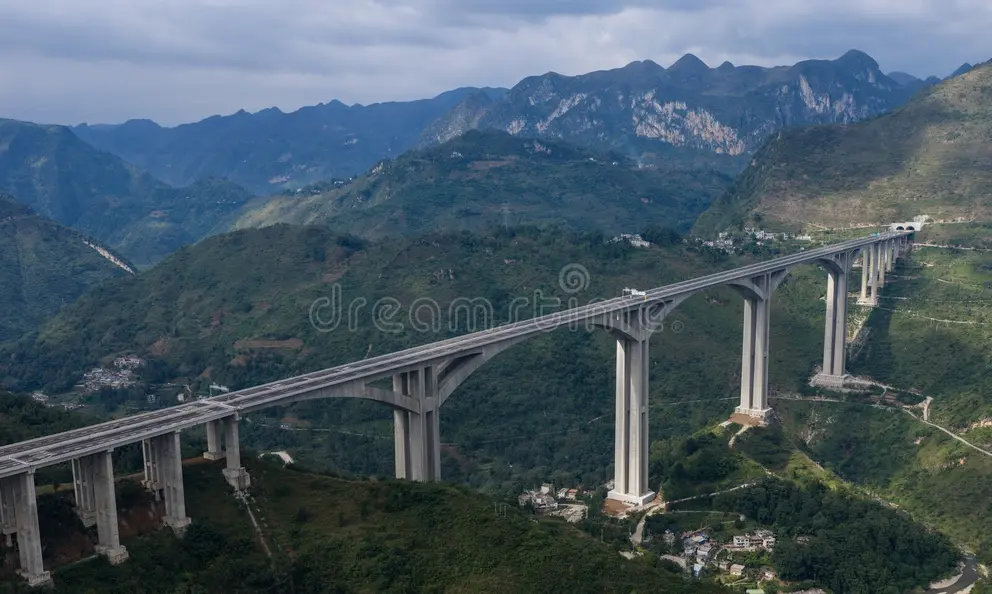
The study is related to the assessment of performance of a long multi-span railway bridge with through type open web superstructure and located in the highest seismic zone of India under simultaneous action of earthquake and moving train. Piers are tall with heights varying from 60 to 140 m and are expected to show significant amplification of seismic response at pier top level. In a long bridge, spatial variation in the input seismic excitation should be considered the effect of this variation at different pier foundation levels on the overall seismic performance of the bridge must be assessed. A detailed finite element model with soil-structure interaction is considered. Asynchronous ground motions are modelled using conditional simulation that accounts for the coherency losses and a time delay of arrival with change in phase as well as amplitude of the earthquake signals from origin to the spatial points of interest along the bridge. "Multi-support excitation of the bridge is performed by converting the acceleration time history to displacement time history. A 27 DOF vehicle model is used to assess the safety of moving train, while the bridge is simultaneously acted upon by an earthquake shaking. The responses at different pier locations for the synchronous and asynchronous motion are evaluated and the requirement of asynchronous input in multi-support excitation for long bridge with tall piers are observed to be significant for assessment of safety of running vehicle.